

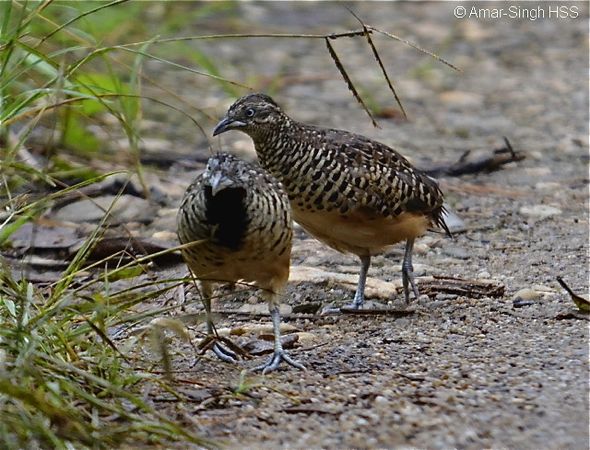
“These Barred Buttonquail ((Turnix suscitator atrogularis) are often seen but hard to observe for prolonged periods. Was out with my wife, just wandering around when we saw a pair on an overgrown path (there were actually three as we found out later). [Above is the pair, female with black throat on the left, male without on the right]. We decided to stay in our vehicle and watch. They slowly ambled towards us, foraging along the way, until they were just outside my wife’s side of the car. Was good to be able to watch for an extended period. Managed to get some images and videos (below).
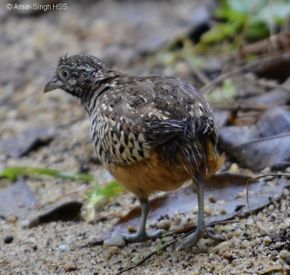
“The male, quite timid compared to female who came closer a number of times during the encounter, can look different in different body postures. The rear view of the female shows lovely blue purple on tail feathers I have not had a chance to see before. …Not exactly sure what they feed on, but appeared to be animal prey (small insects?). Was happy to share feeding space with Peaceful Doves.”
Dato’ Dr Amar-Singh HSS
Ipoh, Perak, Malaysia
7th November 2011
Location: Ex-mining pools, Ipoh, Perak, Malaysia
Habitat: Over paths near limestone hills








3 Responses
Very nice video! It’s great to watch them foraging and even doing a little preening. It surprises me that the male was more secretive – not what I would have expected. By the way do you know what bird was calling loudly in the early part of the video? (I’m quite poor at bird calls, and don’t know if this one is obvious or difficult to identify.)
Those calls are most likely the melodious calls of the Pied Fantail.
Thanks!